
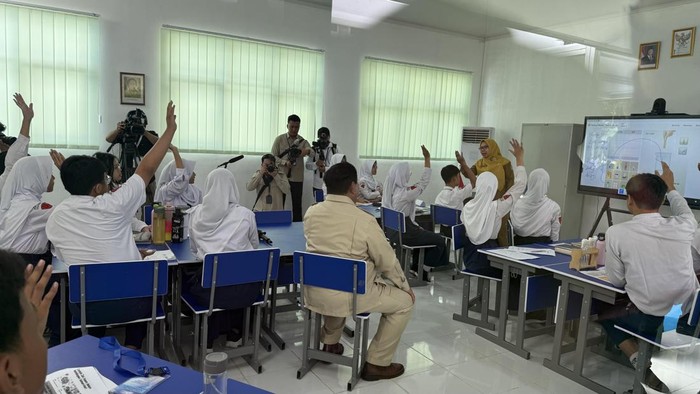
Jakarta – Equal distribution of education has become one of the main focuses in the Asta Cita Prabowo–Gibran program. Through various breakthroughs, the government continues to strive to ensure education services that are evenly available, modern, and relevant for all Indonesian students.
One of the flagship programs is Sekolah Rakyat (People’s Schools), strengthened through cross-agency collaboration such as the Ministry of Primary and Secondary Education (Kemendikdasmen), the Ministry of Higher Education, Science and Technology (Kemendikti), the Ministry of Social Affairs (Kemensos), and the Ministry of Communication and Digital Affairs (Komdigi). Digitalization has become a crucial key in expanding access to education, especially for 3T regions (Disadvantaged, Frontier, and Outermost areas).
Komdigi also takes a strategic role in providing solutions that can bridge learning gaps across every corner of the country.
Transformation Push: From PHTC to Learning Digitalization 2025
Within the framework of education modernization, President Prabowo Subianto launched the Best Quick Results Program (PHTC), a step aimed at improving education quality equally. One tangible form of this is the installation of smartboards or interactive flat panels (IFP) in schools throughout Indonesia.
The Learning Digitalization 2025 Program was officially launched at SMPN 4 Bekasi City, West Java (17/11). This initiative marks a milestone in accelerating a national education transformation that is more interactive, adaptive, and enjoyable for students.
“What we have just witnessed is our program as an effort to accelerate the transformation of our national education,” Prabowo said, quoted from Antara on Tuesday (2/12/2025).
Prabowo emphasized that education transformation is not merely about distributing devices, but about building a learning ecosystem that is creative, inclusive, and fair for all children of the nation.
Distribution of Digital Devices for Schools Across Indonesia
The Learning Digitalization Program includes the provision of equipment such as Interactive Digital Boards (IFP), laptops, content storage media, satellite internet, and solar panels for schools that are not yet reached by electricity or stable internet networks.
To date, a total of 215,572 devices have been sent. 172,550 devices have already arrived at recipient schools, while 43,022 are still in the delivery process. The government is targeting full distribution before December 2025.
To optimize the use of these devices, the government also provides quality learning content through the Rumah Pendidikan platform, complete with technical guidance for teachers.
Recognizing the importance of this role, detikcom presents the “Apresiasi Konektivitas Digital” (Digital Connectivity Appreciation Awards) as a form of recognition for individuals, groups, or institutions that contribute to opening digital access to remote areas. This event also highlights various inspiring stories behind efforts to provide equal connectivity.
One of the categories introduced is Digital Model School, an award for schools that successfully adopt learning that is efficient, adaptive, and digitally oriented. Schools in this category are considered capable of becoming examples in creating digital breakthroughs to support students’ learning activities.
Through this event, detikcom opens opportunities for the public to nominate figures, communities, or institutions considered to have made major contributions to strengthening digital connectivity, especially in 3T regions. The submission process can be done through detik.com/apresiasikonektivitasdigital.
Nomination Submission Requirements:
One proposer may submit only one nominee.
The submission period runs from 15 November 2025 – 15 January 2026.
Submissions must include supporting evidence such as photos, videos, or relevant documents.
Through the Digital Connectivity Appreciation Awards, detikcom wants to provide space for digital champions across Indonesia who have helped open access to technology as a bridge toward prosperity. This initiative is expected to strengthen collaboration between government, companies, and society in achieving equal digital connectivity in Indonesia.
With increasingly equal digital access, communities—including those in 3T regions—will have equal opportunities to learn, grow, and be competitive in the digital era.