
Author: Oleh Ivan Setyadhi
The Deputy Minister of Primary and Secondary Education, Fajar Riza Ul Haq, affirmed that the distribution of Interactive Flat Panels (IFP) to schools is part of President Prabowo Subianto’s education revolution to respond to the challenges of the digital era.
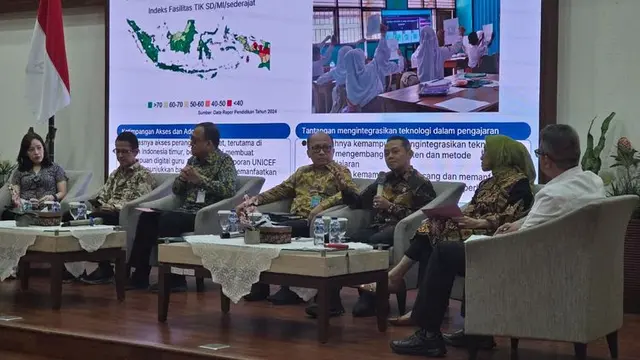
He conveyed this at a Round Table Discussion (RTD) organized by Lemhanas RI under the theme “Improving the Competence of Excellent Human Resources through Multi-Stakeholder Collaboration in the Digital Era” on Thursday (4/12/2025). According to him, as of 4 December 2025, out of a total of 288,865 educational units in Indonesia, 257,988 have received the devices as a step toward equalizing access to learning in the digital era.
For Deputy Minister Fajar, the education revolution during President Prabowo’s era actually has a historical trace that cannot be separated from the role of President Prabowo’s father, Prof. Sumitro Djojohadikusumo, who in 1978 became Deputy Chair of the Education Reform Commission formed by Minister of Education Daoed Joesoef.
That commission produced a policy framework that led to the National Education System Law (UU Sisdiknas) No. 2 of 1989, and emphasized the importance of the correlation between education, economic growth, and national prosperity.
Deputy Minister Fajar recounted his visit during National Teachers’ Day at SMAN 1 Manokwari, followed by a trip to Mansinam Island, where he witnessed children’s learning activities at SD Inpres 10 Mansinam. The school was built through Inpres Program No. 10 of 1973 during President Soeharto’s era, which within six years succeeded in building more than 61,000 elementary schools. “That elementary school can be said to be an educational infrastructure revolution in Pak Harto’s era. And the good news is that SD 10 Mansinam has now also received an IFP. This is proof that digital equity truly reaches even the outermost islands,” he said.
Meanwhile, the Governor of Lemhannas, T.B. Ace Hasan Syadzily, stated the need for a leap in national education in the digital era. “In a world that is moving so fast, we must dare to comprehensively improve the education ecosystem. And we see today that President Prabowo has a strong commitment to advancing education,” he said.
The Deputy Chair of Commission X of the House of Representatives (DPR RI), Hetifah Sjaifudian, added that accelerating educational transformation can only happen through joint work. “Education cannot progress without multi-stakeholder collaboration,” she stressed.
Deputy Minister Fajar again emphasized that the Ministry of Primary and Secondary Education under the leadership of Minister Abdul Mu’ti always upholds the spirit of broad participation. “Education is a national project. The central government, regional governments, including Lemhannas, universities, the business world, schools, and society must move forward together. Only through collaboration can we prepare an excellent generation ready to face the challenges of the digital era,” Deputy Minister Fajar concluded.