
Author: Hairul
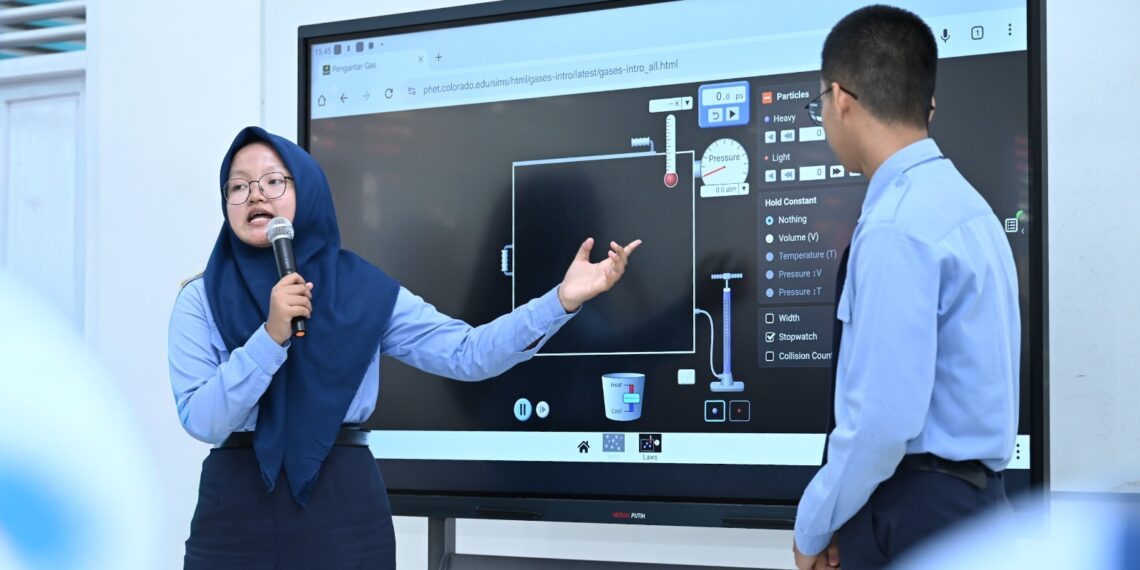
koranindopos.com – Jakarta. Science learning in schools, which was previously synonymous with memorizing formulas, is now beginning to shift toward a deeper understanding of concepts. The use of Digital Interactive Boards (DIB) enables abstract materials, such as the kinetic theory of gases, to be visualized concretely, making them easier for students to understand.
This transformation of learning methods is part of the policy of the Ministry of Basic and Secondary Education (Kemendikdasmen) through the Learning Digitalization program. The program promotes the application of a deep learning approach so that students do not merely memorize formulas, but are able to understand scientific processes in a holistic and contextual manner.
The benefits of using DIB are felt directly in classrooms. The principal of SMAN 1 Indralaya, Pudyo Laksono, stated that digital interactive boards help teachers explain scientific concepts that were previously difficult for students to imagine.
“In lessons on the kinetic theory of gases, especially Boyle’s law, students no longer simply memorize the relationship between pressure, volume, and temperature. Through digital interactive boards, they can directly see visualizations of particle movement,” Pudyo said in a written statement received by InfoPublik on Monday (January 26, 2026).
According to him, simulations displayed through DIB allow students to observe increases in pressure when gas particles are compressed within a container, complete with indicators showing rising pressure levels. These visualizations help students understand scientific concepts logically and more easily.
As of January 2026, all schools in South Sumatra Province have reportedly received support in the form of DIB. At the school level, their use is carried out collaboratively through teacher learning communities. At SMAN 1 Indralaya, the school’s quality assurance team has even developed pilot projects and disseminated best practices to other teachers, including establishing standard operating procedures to ensure the equipment remains durable and functions optimally.
A similar experience was shared by the principal of SMPN 1 Lubuk Liat, Marion, who considers DIB an important tool for introducing greater variety in learning in line with technological developments. He added that students experience no difficulty adapting, as the DIB system is Android-based, a platform already familiar in their daily lives.
Meanwhile, the principal of SDN 6 Pemulutan Barat, Desi Huswinda, believes that the presence of DIB helps create a more dynamic and enjoyable classroom atmosphere, especially for elementary school students in rural areas. According to her, the use of DIB represents a concrete step toward providing equitable access to education, including for schools that previously faced limitations in learning facilities.
The implementation of Learning Digitalization through DIB emphasizes the direction of Kemendikdasmen’s policy, which positions technology as a means to strengthen meaningful learning rather than as an end in itself. Technology is utilized to foster critical thinking, strengthen conceptual understanding, and adapt the learning process to scientific advancements and the demands of the modern era.
The Minister of Basic and Secondary Education, Abdul Mu’ti, emphasized that the Learning Digitalization program was designed not only to meet educational infrastructure needs, but also to reach regions facing geographical challenges.
“Learning Digitalization reaches more than 288,000 educational units across Indonesia. We hope that the provision of these facilities will become a shared commitment to delivering quality educational services,” he stated.
He added that, particularly for hard-to-reach areas, the government provides comprehensive assistance packages. “We do not only deliver digital interactive boards, but also support the provision of electricity and internet connectivity through Starlink, so that the equipment can be optimally utilized to support learning, including distance education,” Abdul Mu’ti concluded. (hai)