
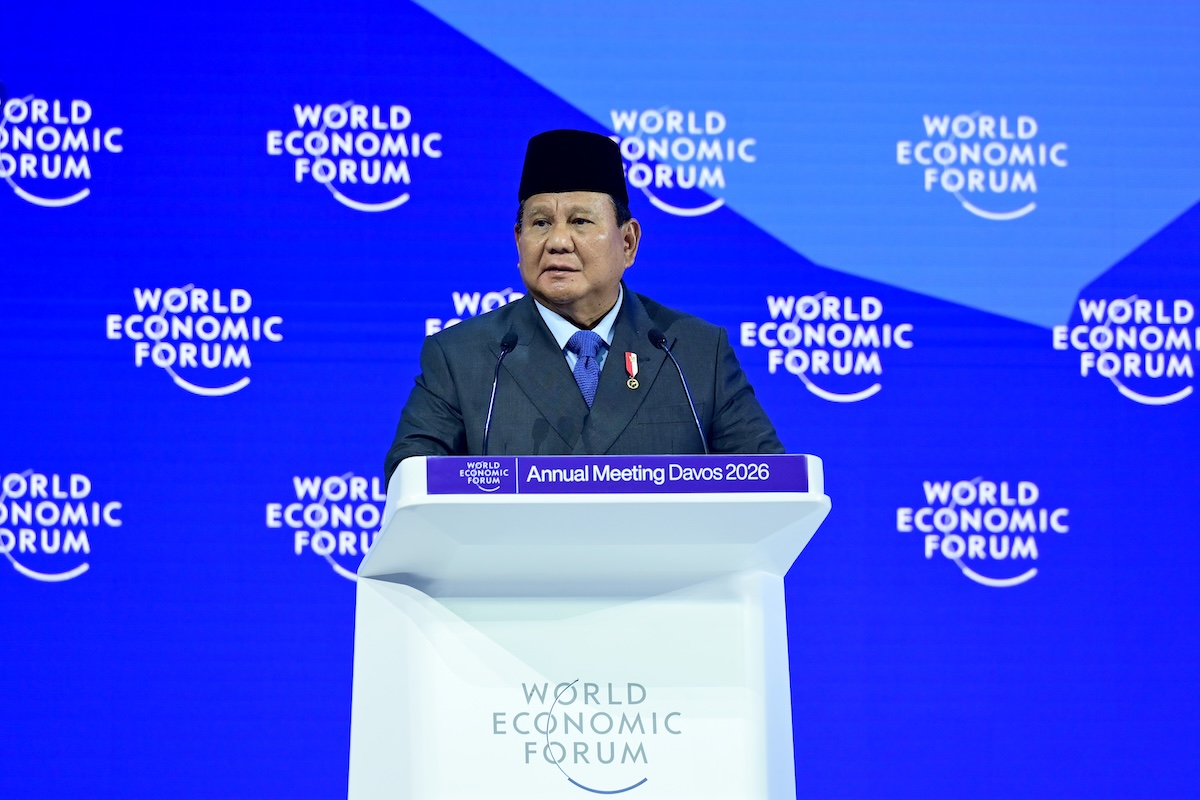
Jakarta (ANTARA) – President Prabowo Subianto plans to directly monitor learning activities in classrooms across various regions of Indonesia using smart board / interactive flat panel (IFP) devices that have already been distributed to a number of schools.
In front of regional leaders and central government officials, President Prabowo announced that the government has so far distributed 282,180 smart boards to schools throughout Indonesia, including those in frontier, outermost, and underdeveloped (3T) areas.
“Almost all schools, including the most remote, isolated, and underdeveloped ones, have already received (smart boards). On remote islands, on the highest mountains, they already have interactive panels,” President Prabowo said during the 2026 National Coordination Meeting between the Central Government and Regional Governments at SICC, Bogor Regency, West Java, on Monday.
The President has set a target for each school to have at least three smart boards. The full rollout of these additional boards is expected to be completed in 2026.
“This year, my goal is for each school to receive at least two more units, so that there will be at least three equipped classrooms—hopefully four. By the end of 2028–2029, every classroom across Indonesia will have an interactive digital panel. What does this mean? We can teach from Jakarta. Schools that lack teachers—math teachers, English teachers, physics teachers, biology teachers—can receive interactive instruction from the center. Eventually, I myself will be able to see whether a classroom actually has a teacher or not,” the President said.
The digitalization of classrooms is one of President Prabowo’s priority programs and has been implemented since 2025. In addition to distributing smart boards, the President has also instructed his staff to immediately renovate tens of thousands of schools across various regions of Indonesia.
In a separate statement, the Minister of Primary and Secondary Education, Abdul Mu’ti, said that the government plans to add up to three IFP units so that each school will have four smart boards.
Abdul Mu’ti believes that the presence of smart boards will ease teaching and learning activities, as the devices can create a more interactive and engaging learning environment for students.
IFPs differ from conventional smart boards because they are all-in-one devices that function simultaneously as a monitor, a computer, and an interactive digital board. These devices can be used without an internet connection, with learning materials downloadable through the Ruang Murid channel on the Rumah Pendidikan platform.