
Author: Kumparan Team
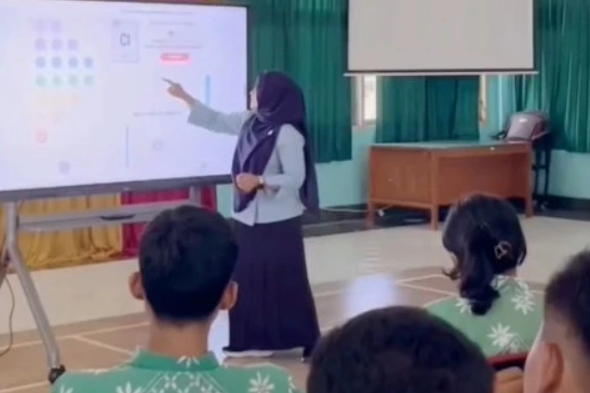
Digital learning innovation is beginning to bring new color into classrooms. Digital Interactive Boards (PID) or Interactive Flat Panels (IFP), which are part of President Prabowo Subianto’s program through the Ministry of Primary and Secondary Education, are now being increasingly optimized. One example can be seen in Chemistry lessons for 11th-grade students at SMA Negeri 1 Seyegan, Sleman Regency, Special Region of Yogyakarta.
The use of PID demonstrates how technology-based educational transformation not only enhances academic understanding, but also opens space for students to reflect and design their future. From a classroom in Sleman, digital technology becomes a bridge between science, character building, and the aspirations of Indonesia’s young generation.
The enthusiasm for using this technology was captured in an Instagram post by Yuli Nestiyarum, a Chemistry teacher at the school. She shared the joyful atmosphere of class XI F1 students during their first Chemistry session, which was designed in three interactive stages.
“The first stage is a review of electron configuration material. At this stage, students collaboratively fill in electron configurations using subshell rules by utilizing the Virtual Lab feature in Ruang Murid on the Rumah Pendidikan platform,” Yuli wrote.
Entering the second stage, learning no longer focuses solely on pure scientific concepts, but is also linked to relevant global issues.
“In the second stage, students are introduced to various global climate changes, one of which is global warming. This material is taken from educational games available in Ruang Murid on Rumah Pendidikan,” she continued.
Through this approach, students are encouraged to understand science contextually. Yuli hopes this method will foster environmental awareness from an early age.
“The hope is that they will become more concerned about environmental sustainability for a better future,” she expressed.
The third stage became the most personal moment: self-reflection. Using the Digital Interactive Board, students appeared highly enthusiastic as they took turns expressing their creativity on the device.
“The third stage is reflection. All students reflect on themselves with the theme ‘I Want to Become…’ directly on the Digital Interactive Board,” she explained.
According to Yuli, this reflection serves as a motivation booster for students to plan their future more seriously.
“This reflection encourages students to participate earnestly in learning in order to realize their dreams. Stay motivated, my children—never stop learning, friends,” she concluded.