
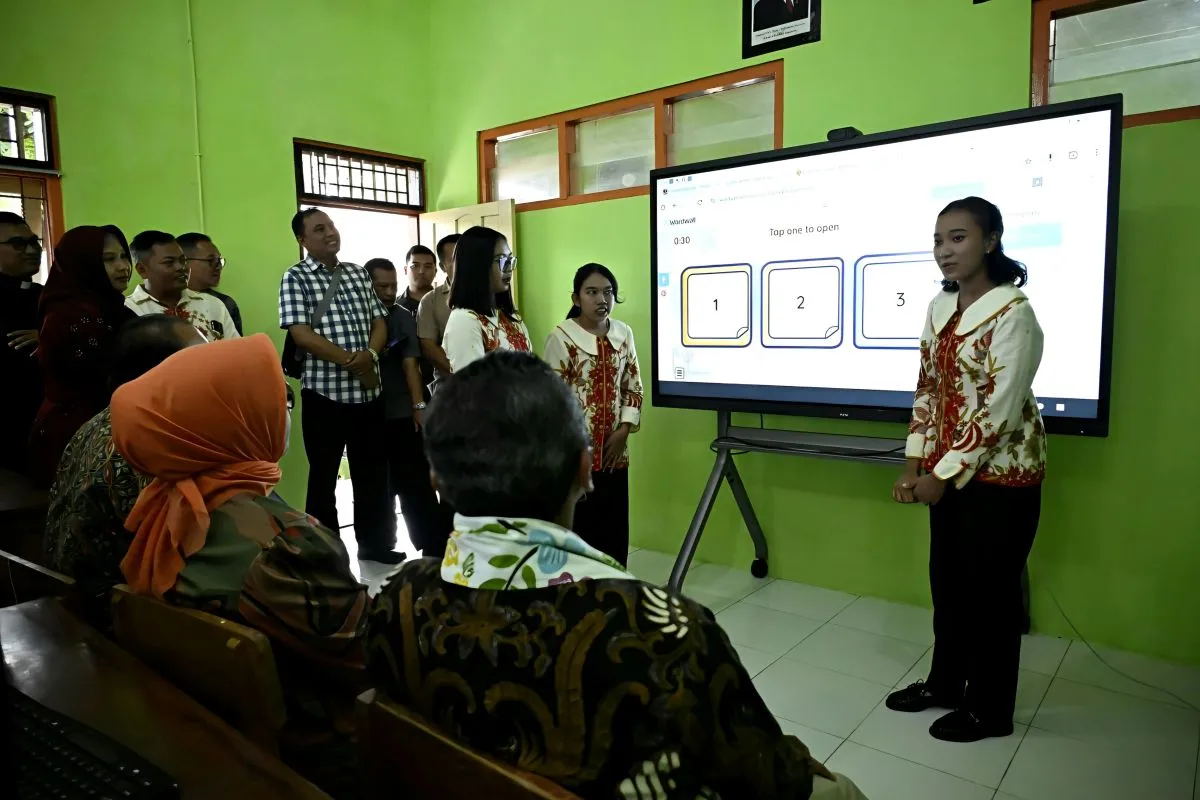
Jakarta (ANTARA) – The Deputy Minister of Primary and Secondary Education (Wamendikdasmen), Fajar Riza Ul Haq, reviewed the implementation of the learning digitalization program through the use of Interactive Flat Panel (IFP) assistance at SD Katolik Krida Dharma, Blora Regency, Central Java Province.
During the visit, Deputy Minister Fajar emphasized that the presence of digital technology in learning does not replace the role of teachers, as teachers remain the main actors in the education process, while IFP serves as a supporting learning medium.
“Teachers remain the key. The IFP is the learning medium,” said Deputy Minister Fajar in a written statement in Jakarta on Monday.
Therefore, he encouraged teachers to optimize the use of the Ruang Pendidikan platform as a digital learning resource.
Ruang Pendidikan, he explained, is a super-application that integrates various educational services into a single platform, including interactive learning videos, articles, virtual laboratories, educational games, and practice questions, which can be accessed by both teachers and students.
One of the teachers at SD Katolik Krida Dharma, Anik Sulifah, stated that IFP is an effective learning medium because it is able to accommodate diverse student learning needs.
“For example, through video displays, audio, or other educational games that can be directly touched by students, creating active participation in learning,” said Anik.
According to her, the use of IFP also has a positive impact on teacher competence, as it allows educators to develop learning ideas that were previously difficult to implement and encourages them to continuously keep up with developments in educational technology.
From the students’ perspective, she added, the use of IFP makes them more active, creative, and enthusiastic in participating in learning activities.
“In previous learning using projectors, students learned through reading, listening, or watching. With the features of IFP, the screen can be controlled and touched, allowing children to be directly involved in the material being delivered,” she added.
Through the learning digitalization program and the provision of IFPs in schools, the Ministry of Primary and Secondary Education (Kemendikdasmen) aims to deliver learning that is more adaptive, inclusive, and relevant to the needs of students.
The use of technology supported by teacher competence is expected to improve the quality of learning.