
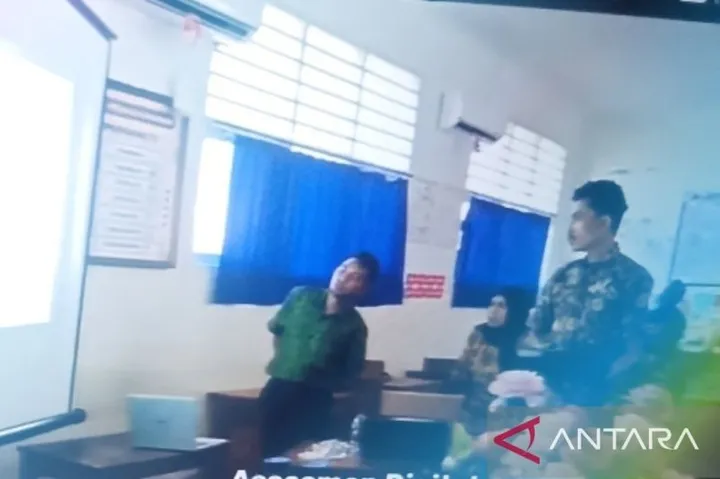
The Biak Numfor Education Office has confirmed the Ministry of Primary and Secondary Education’s (Kemendikdasmen) program to provide Smart TVs for Digital Learning, aimed at equalizing education quality. What benefits will schools gain?
The Department of Education and Culture (Disdikbud) of Biak Numfor Regency, Papua, announced a Smart TV monitor assistance program from the Ministry of Primary and Secondary Education (Kemendikdasmen). The program is designed specifically to support the digitalization of education across various educational units. Head of the Biak Numfor Education and Culture Department, Kamaruddin, stated that this initiative aims to strengthen a comprehensive and inclusive digital-based learning ecosystem.
Kamaruddin explained that this monitor assistance is part of the Digital Interactive Board or Interactive Flat Panel (IFP) program that will be distributed to schools. He added, “This program is designed to promote equal access to technology-based education and strengthen a comprehensive and inclusive digital learning ecosystem.” The implementation of IFP devices is expected to support learning processes in the digital era. This aligns with the government’s efforts to improve education quality through the use of modern technology.
The Smart TV Digital Learning assistance program is not only focused on infrastructure improvement but also on reducing educational disparities. With these advanced devices, teaching and learning processes are expected to become more effective and enjoyable for all students. The government has also ensured that this program will reach all types of schools, including Special Needs Schools (SLB).
Advancing Education Quality Through Technology
Kemendikdasmen’s Smart TV monitor assistance program carries a major vision: to create equal access to quality education throughout Indonesia, especially in Biak Numfor. Kamaruddin emphasized that the program is specifically designed to drive quality education based on technology. Through IFP devices, schools are expected to adopt more modern and interactive learning methods.
The use of Interactive Flat Panels (IFP) will have a significant impact on classroom learning environments. Lessons will become more effective and enjoyable, helping to increase students’ interest and understanding. The monitor assistance directly streamlines the teaching and learning process with the support of advanced technology.
The main goal of providing Smart TVs for Digital Learning is to strengthen a comprehensive and inclusive digital learning ecosystem. This means that every school, without exception, has equal opportunity to access educational technology. As a result, educational disparities caused by limited technological infrastructure can gradually be reduced.
Data Collection Mechanism and Program Inclusivity
To ensure the distribution of Smart TVs for Digital Learning is accurate and targeted, Kemendikdasmen uses the Dapodik application as its data source. The program is verified through Dapodik, which allows schools to register or be validated as recipients of the learning monitor devices. This process ensures transparency and accountability in the allocation of assistance.
Kamaruddin also stressed that the government’s IFP assistance specifically targets Special Needs Schools (SLB). This initiative is a concrete form of commitment to achieving inclusive and gap-free education. Thus, students with special needs can also benefit from innovative digital learning technologies.
As of now, the Biak Numfor Education Office is still awaiting data on the number of schools that will receive the monitor assistance. Data collection is carried out directly through the Dapodik system by Kemendikdasmen. However, Kamaruddin remains optimistic that the monitors will greatly support smooth digital learning processes in every educational unit that receives them.