
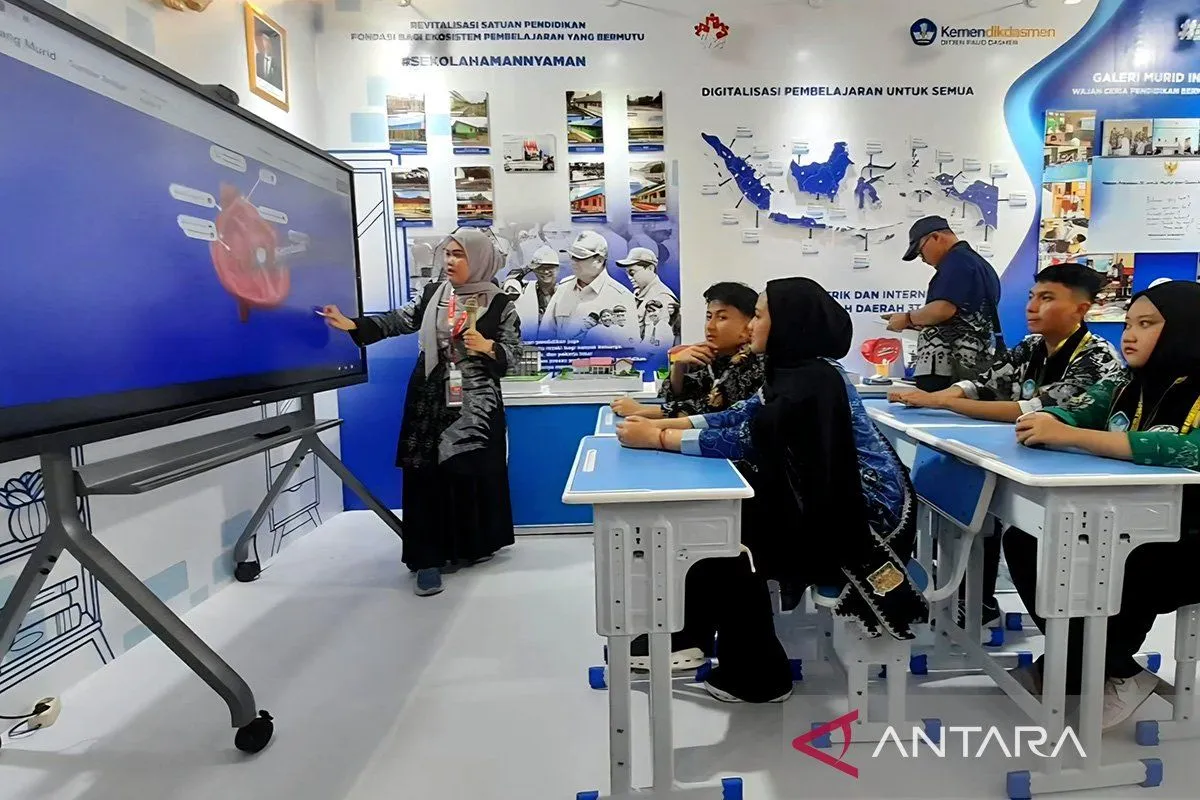
Jakarta (ANTARA) – The Ministry of Primary and Secondary Education (Kemendikdasmen) has received appreciation from several teachers and education administrators regarding the implementation of the learning digitalization program through the distribution of Digital Interactive Boards (PID) or Interactive Flat Panels (IFP), as they have fostered innovation in classroom learning.
Alexander Rendi, a teacher at SMAN 1 Samarinda, East Kalimantan Province, who teaches grades 10 and 11, stated that the device is almost always used in the teaching and learning process.
“Every time I enter the classroom, I always use the IFP as a learning medium,” Alexander said in Depok City, West Java Province, on Wednesday.
According to him, visually based learning materials are most effective when delivered through PID because they capture students’ attention and enhance learning focus.
In addition to presenting materials, he explained that PID is also used to introduce interactive games that directly involve students, creating a more dynamic classroom atmosphere and encouraging active participation.
The use of PID or IFP has also increased interaction between teachers and students.
However, Alexander emphasized that the role of educators remains key to successful learning.
“PID is a supporting tool. Whether learning is engaging or not depends greatly on how the teacher uses it,” he said.
As a history teacher, he consistently presents visual content to help students better understand past events.
One learning innovation implemented is the use of virtual museums accessed through PID.
Through this technology, students are invited to directly observe historical artifacts as if they were inside a museum.
This method is considered effective in bringing historical information into the classroom and stimulating students’ curiosity, which then encourages interaction and discussion during lessons.
On another occasion, Syarafudin, Head of the Elementary School Development Division at the Mataram City Education Office, West Nusa Tenggara Province, stated that the office provides comprehensive support to ensure that PID is truly utilized in classroom learning.
He mentioned that the support includes training teachers in the use of PID, strengthening policies that promote the use of technology in learning, facilitating the dissemination of best practices, and providing guidelines for PID utilization to ensure alignment with learning objectives.
In addition, the Mataram City Education Office provides continuous assistance through school supervisors in academic supervision activities, best practice dissemination, and forums for sharing experiences among teachers and schools.
The assistance focuses on using PID as an interactive medium rather than merely a presentation tool, so as to enhance student engagement and create two-way interaction in the learning process.
Through collaboration among teachers, schools, local governments, and the central government, Kemendikdasmen hopes that the use of PID will strengthen the digital transformation of education and sustainably improve the quality, interaction, and effectiveness of teaching and learning in schools.