
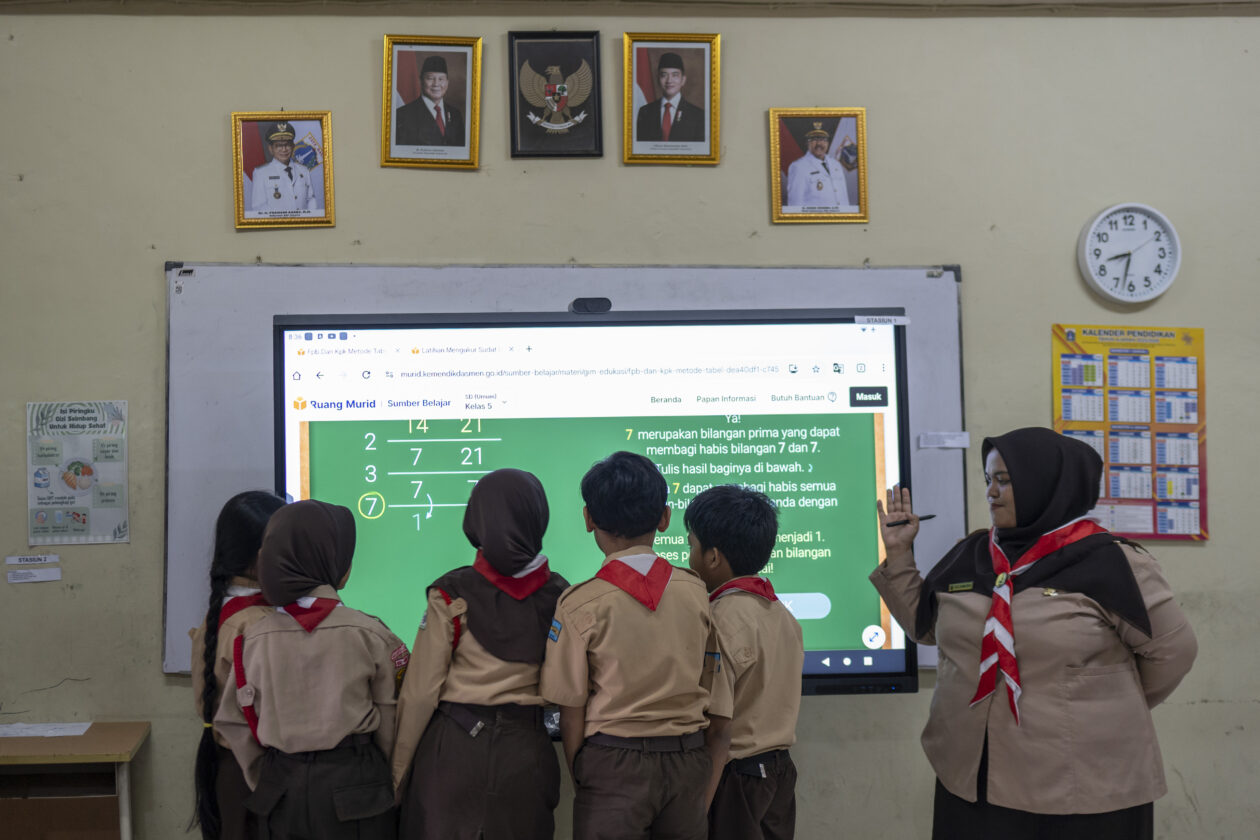
Schools and Community Learning Activity Centers (PKBM) in Indonesia continue to experience the benefits of the Digital Interactive Board (PID), following the distribution of 288,865 PIDs throughout last year.
President Prabowo, in the latest Plenary Cabinet Meeting, stated that the number will increase this year with an additional three PIDs per school, while next year two more screens will be added, so that each classroom will have a PID and the target of one million PIDs across Indonesia will be achieved.
In addition, the government plans to establish a centralized teaching studio in Jakarta to provide high-quality educational content, especially to 330,000 schools that face difficulties in accessing qualified teachers and quality materials. Affordable internet technology will also be introduced to address internet/WiFi connectivity issues.
Head of the Data and Technology Center at the Ministry of Primary and Secondary Education, Yudhistira Nugraha, stated that the digitalization of learning through PIDs and other initiatives demonstrates the government’s commitment to building a comprehensive ecosystem.
“Digitalizing education is not merely about providing devices, but about building an ecosystem that includes technology, content, and continuous teacher competency development,” he said while moderating the Webinar Launch of the Independent Training Program on the topic “Utilizing Digital Interactive Boards in Learning,” held recently.
The event is part of efforts to accelerate digital transformation in education through the optimization of PIDs. Through Independent Training in the GTK Space within the Rumah Pendidikan super app, teachers can flexibly access materials using their belajar.id accounts. The training materials cover an introduction to PID features, interactive pedagogical strategies, and classroom implementation practices.
The Director General of Teachers, Education Personnel, and Teacher Education, Nunuk Suryani, emphasized that digital transformation also depends on teachers’ readiness and willingness to continuously learn.
“Educational transformation begins with adaptive teachers who continue learning. Technology will have an impact when it is used to create student-centered learning,” she explained.
The Director of Vocational High Schools, Arie Wibowo Khurniawan, highlighted the relevance of PIDs in vocational education. “In vocational schools, Digital Interactive Boards enable industrial simulations and work-based project presentations, making learning more authentic and efficient,” he stated.
Claudia Puspita, an Informatics teacher at SMP Negeri 2 Ende, East Nusa Tenggara, explained that before the introduction of PIDs, classroom learning was limited to LCD screens, so students could only watch. “Since the PID was introduced, students can interact more because there are many engaging games and quizzes presented interactively. As a result, they are always enthusiastic about using the PID, even for ice-breaking activities,” she said.
A student of SMP Negeri 2 Ende, Aca Putri, expressed her excitement, saying that the PID has increased her interest in learning. “Before this interactive board, I sometimes felt bored in class. I hope more PIDs will be added,” she concluded.
The Principal of SMAN 1 Indralaya, South Sumatra, Pudyo Laksono, explained that the presence of the interactive board greatly helps students understand subjects that were previously difficult to visualize. For example, when teachers demonstrate the Kinetic Theory of Gases.
“Regarding the kinetic theory of gases in Boyle’s Law, for instance, students no longer merely abstract the relationship between pressure, volume, and temperature, but can directly see the visualization of particle movement through the digital interactive board,” he explained.