
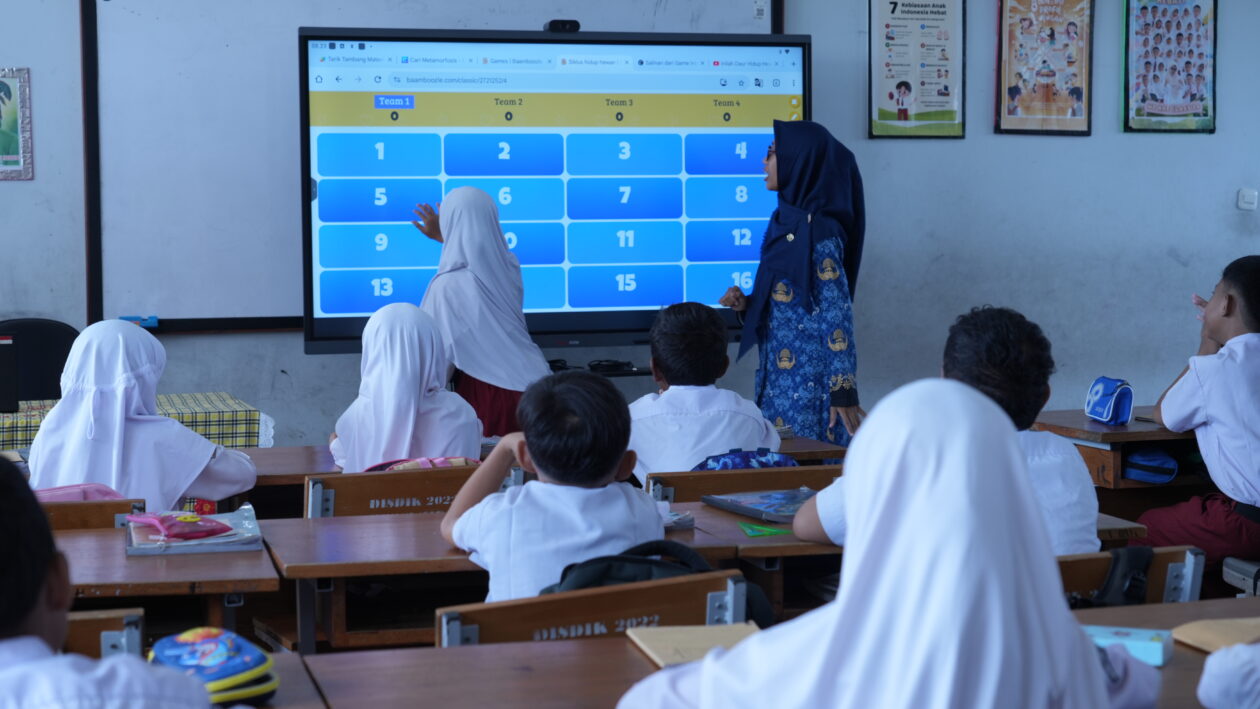
The digital interactive board devices are considered helpful in restoring learning amid limited facilities in the post-disaster period.
SEVERAL schools in Bener Meriah Regency, Aceh, affected by flooding have begun to resume teaching and learning activities by utilizing digital interactive boards (PID) or interactive flat panels (IFP). These digital devices are considered to support the recovery of the learning process amid limited infrastructure following the disaster.
The use of IFPs has been observed at SMAN 2 Timang Gajah, SDN Karang Jadi, and SMP Muhammadiyah 11 Teritit. All three schools previously experienced disruptions to learning due to severed road access and damage to school facilities caused by flooding.
The principal of SMAN 2 Timang Gajah, Ikhsan Purnama, said that the presence of IFPs has had a positive impact on the quality of learning. According to him, the devices were immediately activated to support in-depth learning once the school resumed operations.
“The presence of IFPs greatly helps teachers in the learning process. Teaching becomes more structured, and students are much more enthusiastic,” Ikhsan said, as quoted from an official statement on Monday, February 2, 2026.
He added that although their use is still on a rotational basis, the school requires teachers to utilize IFPs in teaching and learning activities. In addition to making teachers’ work easier, IFPs also encourage students to be more active, especially during presentations, as the screen can be touched directly like a mobile device.
The floods had previously forced the suspension of learning activities at the school. Ikhsan noted that at least 15 students were affected, with some of them losing their homes after they were swept away by the floodwaters. The school and teachers took the initiative to provide assistance to affected students.
The principal of SDN Karang Jadi, M. Ghazali, said that IFPs have been in use for the past two weeks, even though learning activities are still being conducted in emergency tents. He stated that the devices are very helpful in maintaining students’ learning motivation in post-disaster conditions. “Now the IFP is already being used; we installed it in the learning tent. This is assistance from President Prabowo,” Ghazali said.
Out of a total of 12 classes at SDN Karang Jadi, six classes use IFPs on a rotational basis. Difficulties in moving the devices between classrooms are caused by the school’s terrain. Nevertheless, students’ enthusiasm remains high. “The students are very enthusiastic; everyone wants to come to the front and learn using the IFP,” Ghazali said.
A similar experience was also reported by SMP Muhammadiyah 11 Teritit, which was isolated for nearly three weeks due to disrupted road access. The school principal, Habsah, said that having IFPs available before the disaster greatly helped ensure the continuity of learning amid limited access.
“We are grateful that the IFPs were already available before the disaster. This equipment has been extremely helpful in supporting the learning process amid limited access,” Habsah said.
The Ministry of Primary and Secondary Education stated that the use of IFPs is part of efforts to support the recovery of learning in disaster-affected areas, while also promoting the quality of technology-based education in the regions.